
Reviewed · FOOD TOURS
Taste & Explore Bali: Denpasar Street Food & Historic Sites
Denpasar’s best food is not always found in Seminyak restaurants. This three-hour evening walk takes you into the city center for Babi Guling, Bakso, traditional Jaje Bali sweets and Arabica coffee, with temples and old civic landmarks along the way. The food is bought locally, and your spending reaches several small stalls rather than one large venue.
I like the mix of food and history, especially the stop at Puputan Square, where the guide explains Bali’s 1906 resistance. I also like the small group limit of 12, which makes it easier to ask questions and watch a guide such as Putra, Irfan, Lena or Srix explain local customs. The main drawback is food choice: vegetarians, vegans and people with gluten allergies cannot be accommodated.
Key points to know before you book

- Babi Guling is the main culinary draw: This ceremonial-style roast pork is not simply a tourist dish. It gives you a direct taste of an important Balinese tradition.
- The route shows central Denpasar beyond resort Bali: You visit Jagatnatha Temple, Puputan Square, Catur Muka and heritage streets around Jalan Gajah Mada.
- The food supports local sellers: Tastings are spread across four to six local food stalls, markets and small businesses.
- The tour begins at 4:00 pm: You finish at Nadhi Heritage on Jalan Gajah Mada, so you need to arrange your own way back.
- It is a walking food tour with a short taxi ride possible: Wear easy shoes and expect a city outing rather than a sit-down restaurant meal.
- The $45 price is reasonable for the scope: It covers several foods, a guide, a three-hour walk and cultural interpretation, but extra food, drinks and gratuities cost more.
Why this Denpasar food tour feels different

Many visitors stay near Seminyak and see Denpasar only from a car window. This experience puts you on foot in the city’s central districts, where temples, government squares, markets, food stalls and old commercial streets sit close together.
That change of setting matters. You are not only tasting Indonesian dishes. You are seeing where local vendors work and where residents buy food for everyday life. The tour supports about four to six small food stalls, so the money spent here is spread through the surrounding community.
The food is locally grown or locally purchased, and the vendors sell it as their living. That does not mean every stop will feel polished or designed for visitors. The reward is a closer look at ordinary Denpasar, with a guide helping you understand what is on your plate and why it matters.
The experience lasts about three hours and begins at 4:00 pm. That timing works well for the heat of the day, though you should expect warm pavement and a fair amount of walking. The route ends at Nadhi Heritage, not back at the temple, so plan your return to Seminyak before you set out.
More eating your way round Seminyak:
- Bali Bites Food Tour with 15+ Tastings
★ 5.0 · 114 reviews - Small-Group Denpasar Night Food Tour
★ 4.0 · 22 reviews - Bali Must-Try Food Tour (Denpasar)
★ 5.0 · 18 reviews
Starting at Jagatnatha Temple
Meet at Pura Agung Jagatnatha, also called Agung Jagatnatha Temple, on Jalan Surapati. This is Denpasar’s central Hindu temple, and it gives the tour a quiet beginning before the food stops take over.
You spend about 15 minutes here. Admission is included at no extra charge, and the guide introduces the temple’s role in Balinese religious life. It is a useful first stop because it gives you cultural context before you begin sampling dishes and walking through the city.
Do not expect a long temple visit or an elaborate ceremony. The stop is brief. Still, it adds meaning to the rest of the evening. Bali’s food customs are closely linked to family, ritual and community, and the guide can connect those ideas to the dishes you try later.
As with any religious site, dress and behavior should be respectful. The supplied information does not specify a dress code or ceremony schedule, so follow your guide’s instructions on the day.
Puputan Square and Bali’s 1906 resistance
The next part of the route brings you to Puputan Square, a symbolic center of Denpasar. Here you learn about the 1906 resistance against colonial rule and the history behind the square’s importance.
This is one of the strongest parts of the experience for anyone who wants more than a meal crawl. The story gives Denpasar a human scale. You are not just passing a public square or photographing a monument. You are learning why the place matters to Balinese identity.
The nearby 0 km landmark marks the symbolic heart of Bali. The stop is short, but the setting helps explain how Denpasar functions as the island’s civic and cultural center.
The history portion may appeal most to adults and older children. If you are mainly interested in eating, the pause can feel like a break from the food. I think it improves the tour, since the meal stops mean more when you understand the city around them.
Catur Muka and the old city streets

At Patung Catur Muka, you stop for about 15 minutes to see Bali’s four-faced god statue and nearby colonial-era landmarks. The monument is easy to recognize and makes a good photo stop, but the guide’s explanation is more useful than the photograph alone.
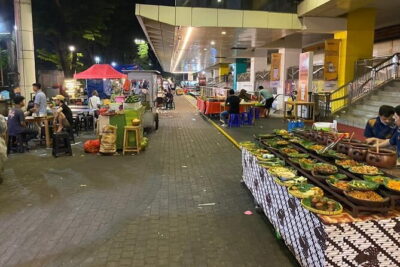
The route then continues along Jalan Gajah Mada. This heritage street combines old buildings, local shops and city traffic. It is a good place to notice how Denpasar differs from the resort areas. The surroundings are practical and lived-in, not arranged for a holiday brochure.
You walk for roughly 30 minutes in this section and try two especially important local dishes: Babi Guling and Bakso. The exact serving order may vary, but the food is the heart of the route.
A few more things to do in Seminyak worth a look
- Bali Unesco World Heritage Sites Tour (Private & All-Inclusive)
★ 5.0 · 91 reviews - Full-day Ubud Private tour : Cultural Heritage
★ 5.0 · 5 reviews - Crafting Heritage Batik Painting Workshops
★ 5.0 · 164 reviews - Jakarta Heritage of Old Batavia Private City Tour (Historical)
★ 5.0 · 143 reviews
Babi Guling and Bakso: two very different tastes

Babi Guling is Bali’s famous roasted pork dish. It is associated with ceremonies and is traditionally not an everyday meal for every occasion. Trying it here gives you a taste of a dish with cultural weight, not just a popular recipe copied for visitors.
Expect strong seasoning and a combination of pork elements rather than a single plain slice of meat. The supplied details do not promise a specific cut, side dish or recipe at every stop, so keep an open mind about the serving. Your guide can explain what you are eating and how it fits into Balinese tradition.
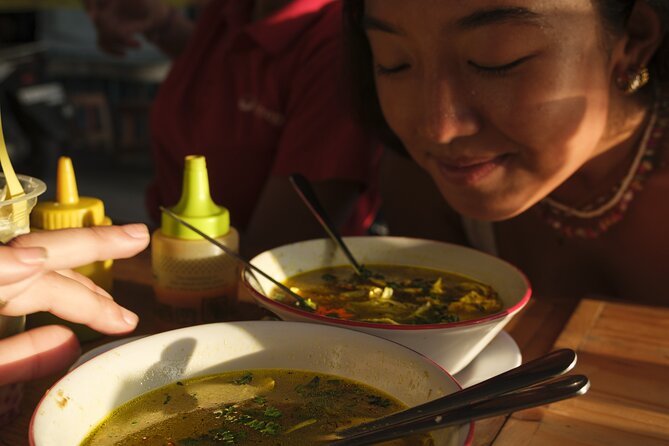
Bakso offers a very different experience. It is Indonesian meatball soup, warm and comforting, and widely loved across the country. The broth and meatballs make it a useful contrast to the roasted pork. Together, the dishes show two sides of Indonesian street food: one linked closely to Bali and ceremony, the other common across Indonesia.
This is also where dietary limits matter most. The tour cannot cater to vegetarian or vegan diets, and it cannot accommodate gluten allergies or intolerances. If you avoid pork or need strict control over ingredients, this is not the right food experience.
Badung Market and Jaje Bali sweets

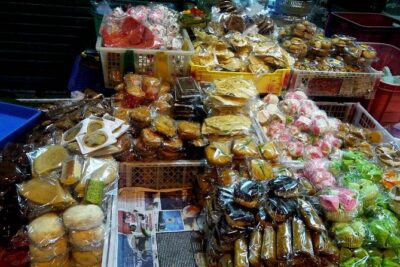
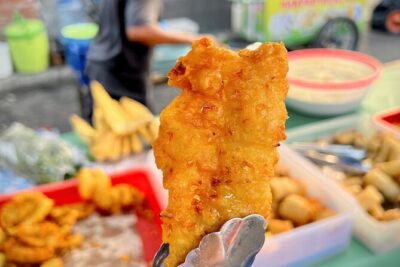
Badung Market is the food-focused center of the tour. You spend about 30 minutes here tasting street food and Jaje Bali, traditional Balinese sweets often made with rice flour and coconut.
Jaje Bali is a broad family of snacks, so the exact pieces may vary. You might find colorful cakes, sticky textures or coconut flavors. These sweets are not necessarily familiar to visitors from outside Indonesia, which is part of the point. Your guide helps you choose and explains what makes each snack different.
The market is also a chance to watch local buying and selling. The vendors are working, not putting on a staged cooking show. That means the experience may be noisy, crowded or a little untidy. Bring patience, and do not expect a quiet table service meal.
If you are nervous about ordering unfamiliar food, this is where a good guide earns the fee. Irfan, for example, has helped people choose local cakes and soup, while other guides named in the tour feedback include Lena, Putra and Srix. Guides can change, but the repeated value of the experience is having someone explain what to try instead of leaving you to guess.
A coffee finish at Nadhi Heritage

The final stop is Nadhi Heritage, a coffee shop on Jalan Gajah Mada. You finish with Indonesian Arabica coffee, served hot or iced.
This is a sensible ending. After walking and eating at several market stops, you get a place to sit and talk through the experience. The coffee also introduces another side of Indonesian food culture without adding another heavy dish.
You should not expect a full café meal here. The included item is authentic Indonesian Arabica coffee, and additional food or drinks are not included. If you want more, you can buy it separately.
The end point is at Jl. Gajah Mada No. 122, while the tour begins at Jagatnatha Temple on Jalan Surapati. That separation is worth noting. You do not return to your starting point, and the route may include a short taxi ride near the end. Arrange pickup from Nadhi Heritage or check public transport options before the 4:00 pm start.
What the $45 price really covers

At $45 per person, this is not the cheapest way to eat in Denpasar. You could buy individual portions at a market for much less. The value comes from combining several tastings with a guided city walk and historical explanation.
Your fee covers Babi Guling, Bakso, Jaje Bali, street food at Badung Market, Arabica coffee, temple and landmark visits, and a guide for about three hours. It also directs business to several local stalls rather than one restaurant.
The small-group limit strengthens the value. With no more than 12 people, the guide can spend more time answering questions and helping with unfamiliar food. A private option is also available, though the supplied price is for the listed per-person experience and does not state the private supplement.
You will still need money for extra snacks, drinks and a tip. Since market portions can be small, hungry eaters may want to budget for additional food. This is a tasting walk, not a dinner with one large final plate.
Timing, group size and practical comfort
The tour starts at 4:00 pm and lasts about three hours. That places most of the activity in the late afternoon and evening, when the route shifts toward market food and coffee.
Wear comfortable shoes. You will walk through temple grounds, public squares, heritage streets and market areas. The experience is described as suitable for most people and near public transportation, but the information does not promise a step-free route or seating at every stop.
Children under six are not permitted. Older children can join, but there are no separate kids’ meals, and the food is local rather than simplified. Families should be comfortable with unfamiliar flavors and a walking route.
Confirmation is provided at booking, and the ticket is mobile. Cancellation is free if you cancel at least 24 hours before the 4:00 pm start. Inside that window, the payment is not refunded, and changes are not accepted.
Who should book this experience
I would choose this tour if you want to see Denpasar as a working city rather than spend another evening in Seminyak. It suits curious eaters, first-time visitors who want help ordering, and anyone who likes history mixed into a food outing.
It is especially good for people interested in Babi Guling and traditional Balinese snacks. The cultural explanation gives those foods context, and the local stalls make the meal feel connected to daily life.
I would not book it if you need vegetarian, vegan or gluten-free food. I would also hesitate if you dislike walking, market settings or shared tasting stops. This is not a polished restaurant tour, and that is both its appeal and its limitation.
Should you book the Denpasar food tour?
Book it if you want a compact introduction to Denpasar’s food, temples, markets and public history. The strongest reasons are the ceremonial connection of Babi Guling, the chance to try Jaje Bali with help from a guide, and the small-group format.
Skip it if your priority is a large dinner, resort comfort or dietary flexibility. For everyone else, $45 is a fair price for three hours of tasting, walking and local context, especially if you have only one evening available for a closer look at Bali’s capital.
FAQ
Where does the tour begin?
The tour begins at Agung Jagatnatha Temple, at Jl. Surapati No. 7, Dangin Puri, East Denpasar.
What time does the experience start?
The start time is 4:00 pm, and the experience lasts about three hours.
Where does the tour end?
The tour ends at Nadhi Heritage on Jalan Gajah Mada, at Jl. Gajah Mada No. 122. It does not end at the starting temple.
What food is included?
Included tastings feature Babi Guling, Bakso, Jaje Bali and other street food at Badung Market, followed by Indonesian Arabica coffee at Nadhi Heritage.
Can vegetarians, vegans or people with gluten allergies join?
The tour cannot accommodate vegetarian or vegan diets, or gluten allergies and intolerances.
Are young children allowed?
Children under six are not permitted. Older children may join, but there are no separate kids’ meals.
What happens if I need to cancel?
You can receive a full refund if you cancel at least 24 hours before the experience starts. Cancellations or changes made within 24 hours are not accepted and are not refunded.
Just added in Seminyak
- Ubud Village Sightseeing, Famous Paddy Field And Ubud Waterfall★ 5.0 · 4 reviews
- Bali Sekumpul with Fiji Waterfall & Bedugul Temple (Private Tour)★ 5.0 · 29 reviews
- Private Nusa Penida Snorkeling Tour★ 5.0 · 30 reviews
- Private Half-Day Tour: Tanah Lot Sunset Trip Packages★ 4.5 · 11 reviews
- Bali Ngurah Rai International Airport Pickup to Ubud Area★ 5.0 · 12 reviews
- Bali Private Car Charter with English Speaking Driver★ 5.0 · 54 reviews
- Bali Tour: The Best Way to Explore The Highlight of Bali★ 5.0 · 16 reviews
- Mount Batur Sunrise Trekking & Hot Spring Tour★ 5.0 · 54 reviews
Food Tours, compared.
Small-Group Walking and Food Tour by Night in Yogyakarta
Read our review →
Night Walking Tour-Malioboro street food with guide at Yogyakarta
Read our review →
Bali Food Tour: Savor Street Food and Night Market Adventures
Read our review →
Experience Jakarta Street Food Scene with MRT Transportation
Read our review →Browse the lists this tour appears in